Thomas Brooks
There is everything in Christ to encourage the greatest
sinners to believe on Him, to rest and lean upon Him for
all happiness and blessedness. Christ is . . .
the greatest good,
the choicest good,
the chief good,
the most suitable good,
the most necessary good
a pure good,
a real good,
a total good,
an eternal good,
a soul-satisfying good!
Sinners, are you poor? Christ has gold to enrich you.
Are you naked? Christ has royal robes, and white clothing to clothe you.
Are you blind? Christ has eye-salve to enlighten you.
Are you hungry? Christ will be manna to feed you.
Are you thirsty? He will be a well of living water to refresh you.
Are you wounded? He has a balm under his wings to heal you.
Are you sick? He is a physician to cure you.
Are you prisoners? He has laid down a ransom for you.
"The unsearchable riches of Christ!" Ephesians 3:8
link
Monday, January 17, 2011


A little picture of Christ!
| (J. R. Miller, "Transformed by Beholding" 1912) | |||
No sooner do we begin to behold the lovely face of Christ, which looks out at us from the gospel chapters, than a great hope springs up in our hearts. We can become like Jesus! Indeed, if we are God's children, we shall become like Him. We are foreordained to be conformed to His image. It matters not, how faintly the divine beauty glimmers now in our soiled and imperfect lives—some day we shall be like Him! As we struggle here with imperfections and infirmities, with scarcely one trace of Christlikeness yet apparent in our life, we still may say, when we catch glimpses of the glorious loveliness of Christ, "Some day I shall be like that!" "For those He foreknew, He also predestined to be conformed to the image of His Son!" Romans 8:29. "We know that when He appears, we will be like Him, because we will see Him as He is!" 1 John 3:2. But how may we now grow into the Christlikeness of Christ? Not merely by our own strugglings and strivings. We cannot make ourselves Christlike by any efforts of our own. Nothing less than a divine power is sufficient to produce this transformation in us. The Scripture describes the process. "Beholding the glory of the Lord, we are changed into the image of the glory." That is, we are to find the likeness of Christ, and are to look upon it and ponder it, gazing intently and lovingly upon it—and as we gaze we are transformed and grow like Christ! | |||
Friday, January 14, 2011
The continued teachings of the Spirit
 | ||
|
Wrought with divine power
 | |
|
Paradoxology
 |
The word "paradox" comes from the Latin word "para" meaning "beyond" and the Greek word "doxa" meaning "popular opinion or belief". In other words a paradox is beyond orthodox, beyond what is popular - or perhaps beyond what we are comfortable with because it is beyond our understanding! Our belief systems can prevent us from seeing beyond the veil of our present understanding... I see many these days who are proclaiming only one side of what is true, and while our reaction in not wanting to see or accept the other side may be understandable, if we are not adjustable we can become adamant, dogmatic and eventually blind to further truth. Often in my passion for what I have seen as a wrong emphasis in me or in others, I have reacted by going to the other extreme. Over the years Father has graciously corrected me through a very good friend who has had to say to me time and time again: "It's not a case of either/or but both/and. Why does it have to be either this or that, why can't it be both?" "Either" and "or" are separating words. "Both" "and" are joining words. When we see things only as either this or that, we can divide and separate what God means to be joined. Obviously there are things which are separate and which we are not meant to join together, but I am thinking of dogmas and opinions of things we have seen which are only half of the truth or one side of the truth and therefore are not the full picture. Often we cling to these "truths" as though our Life depended on them rather than on Christ. There are many characteristics of God given in the Bible which seem to be opposites, yet they reveal to us the many aspects of God. While they may initially appear to be opposites - a paradox - yet both are true and both need to be held in tension with each other in order to achieve a balance. We need to "note the kindness AND the severity of God" (Romans 11:22). The following is given with the prayer that Father will continue to reveal to us both His Truth AND His Grace, that we may truly know, accept and love Him as He really is rather than accepting only those things about Him which we like and understand while rejecting those we do not... God loves AND hates He brings mercy AND judgment He is approachable AND unapproachable He is a consuming fire AND rivers of living water. God delights in spontaneity AND in order He brings sight AND blindness He softens hearts AND hardens them He creates AND destroys. He is knowable AND unknowable He is the Word AND the Spirit He chose us AND we chose Him He is similar to us AND completely other. God's ways are hidden AND seen He is universal AND local He is inclusive AND exclusive He blesses AND curses. Christ is in heaven AND also within me. He is the Prince of Peace AND He brings a Sword He comes to unite AND separate To build up AND tear down. I have been crucified with Christ AND I take up my cross daily I can do nothing myself AND in Him I can do anything My relationship with Him is personal AND corporate Both a journey AND a destination. I am hidden in Christ AND on display for all to see In Him I know true rest AND real work I know the greatest joy AND the deepest sorrow I experience liberty AND restriction. He is my Father AND He is God I am His child AND His servant I am His friend AND His slave I am free AND a prisoner. Christ is the Son of God AND the Son of Man His fragrance brings Life AND death He is the Lamb AND the Lion He is our Brother AND our King. He is revealed AND is delightfully, intriguingly, a Mystery... I want you woven into a tapestry of love, in touch with everything there is to know of God. Then you will have minds confident and at rest, focused on Christ, God's great Mystery. All the richest treasures of wisdom and knowledge are embedded in that Mystery and nowhere else. (Col. 2:2,3). |
The path ahead
 A path lies within our reach, that makes the ordinary Christian life look cold and colourless by contrast; a path leading even beyond that consecration in its lower sense, for this latter may be very subjective in tone, and may hold out the way of obedience chiefly as a means of rest and victory. It is to many of us a distinctly fresh life when God's Spirit leads us to the objective side, lifting our gaze from the road beneath our feet to the form of him who goes before, and riveting it there by his radiant beauty... Then the measure of the sunshine and shadow of our days will be simply in the shining or the veiling of his face. Nothing on earth will make up for the slightest dimming of that light; nothing will really matter that leaves it untouched. *** You may grow so to follow His voice that even your thoughts will be brought "into captivity to the obedience of Christ." This bondage is perfect freedom, for we desire, He and we, only one and the same thing, and the true heartlove makes it all joy to follow, even if the path is narrow and rough. *** It is only as we go into a life of surrender that the blessed joy of pouring out to him our costly things dawns upon us. This giving sets free a spring of conscious love and the love, in its turn, inspires to fresh giving; and though the pain involved is still pain, such a strange sweetness becomes interwoven with it that we wonder whether heaven can be perfect without the possibility of suffering loss for him. To quicken the dead is the divinest of all divine prerogatives. We creatures say, 'While there is life there is hope,' but our Creator will never suffer himself to be so limited. He deliberately delayed until the child was dead, for the faith of Jairus must know him as the God who quickeneth the dead, and with Lazarus he deliberately stayed away until death had established its reign, so that Martha and Mary might know him as resurrection life. So the first answer to many prayers may, therefore, be the reign of death. The last spark of life may be quenched and faith and hope left alone with the dead - and with the God who raises the dead. Do not be dismayed if the first answer to some of your prayers is a revelation, not of the power of God to make alive, but of his might to slay every hope outside of himself. - Lilias Trotter  |
Saturday, January 8, 2011
THE PRAYER OF JABEZ
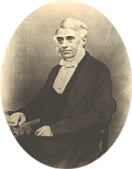
JOSEPH CHARLES PHILPOT (1802-1869)
WEDNESDAY EVENING, APRIL 28, 1841, BY J. C. PHILPOT, AT TRINITY CHAPEL, ALFRED STREET, LEICESTER
"And Jabez called on the God of Israel, saying, Oh, that thou wouldst bless me indeed, and enlarge my coast, and that thine hand might be with me, and that thou wouldst keep me from evil that it may not grieve me! And God granted him that which he requested."- 1Ch 4:10.
I have read that in the sand deserts of Egypt, after the traveller has been passing through barren wilds, with nought but a blazing sun above and scorching sands beneath, he comes sometimes to a green fertile spot, that forms a perfect contrast with the desolate wilderness around, where there are wells of water to refresh his thirst, and palm trees to afford him shade and food. Such it appears was Elim, "where were twelve wells of water, and threescore and ten palm trees," where the children of Israel encamped after wandering in the wilderness for three days without water, Ex 15:22,27; and such was also "Tadmor in the wilderness," 2Ch 8:4, the word signifying a palm tree. There seems something similar to this in the prayer of Jabez recorded in the first book of Chronicles. In reading the first three chapters we had been travelling through a wilderness of names unprofitable and uninteresting to us, though not so to the children of Israel, on the preservation of whose genealogies the lineage of the high priest, and the descent of Christ from David depended, when we light all of a sudden on a green spot, which forms a perfect contrast to the long and "endless genealogies" that we have been toiling through. This green spot is the prayer of Jabez; and here, should the Lord the Spirit lead us into the sweet and rich experience of the passage, we may find in it some green pastures to feed in, and some still waters to lay down by. But why should this be such a green spot? Because all the family of God may, more or less distinctly, read their experience in the prayer of Jabez, and see clearly pourtrayed in it the desires and breathings of their own souls. "As in water face answereth to face, so the heart of man to man," Pr 27:19.
But who was Jabez? We read nothing of him beyond these two features, which the Holy Spirit has stamped his name with: first, that he was "more honourable than his brethren;" secondly, that "his mother called his name Jabez which means" sorrowful", because she bare him with sorrow." As names were generally prophetical in those times, it would seem to imply that he was the sorrowful child of a sorrowful mother. He was certainly cradled in affliction, and as an eminent follower of him who was a Man of sorrows, he doubtless was chosen in the furnace of affliction, and through much tribulation entered the kingdom of heaven. His very petition, "Keep me from evil that it may not grieve me," shows that he knew what grief and trouble of soul were. His first badge, then, was sorrow; and his second was honour. "Jabez was more honourable than his brethren." How more honourable? Not so by birth, for, being of the same parents with his brethren, his lineage could not be more honourable than theirs. Nor by filling any eminent post, for he is not mentioned in any other part of Scripture. Nor by talent, or anything else reckoned honourable by man, for "that which is highly esteemed among men, is abomination in the sight of God," Lu 16:15. His honour was "that which cometh from God only," Joh 5:44, and consisted in his being "a vessel made unto honour" in the original election of God, Ro 9:21, and in the appointed season sanctified by the Spirit as a vessel unto honour meet for the Master’s use, 2Ti 2:21. For "this honour have all his saints," Ps 149:9; and "thus is it done to the man whom the king delighteth to honour," Es 6:9; and be assured that the same two marks, affliction and honour, are stamped upon every living soul, according to the measure of the Spirit’s dealings with him.
"And Jabez called on the God of Israel." From this we gather that he had a spiritual, experimental knowledge of the God of Israel. He did not worship "an unknown God," like the Athenians; nor the God of creation, like the Deist; nor the God of his own fancy, like the Pharisee; nor the God of universal love and mercy, like the Arminian; but "the God of Israel," that is, God in covenant with a peculiar people -Israel being "his inheritance," Isa 19:25; the object of his eternal love, Mal 1:2; and "his peculiar treasure," Ps 135:4. This was the God before whom he bowed down to worship in spirit and in truth, and at whose mercy-seat he poured forth the desire of his soul in the prayer left here upon record.
Subscribe to:
Posts (Atom)