Friday, December 31, 2010

An excellent way of commenting upon the Bible

(Thomas Watson)

"How I love Your teaching! It is my meditation
all day long." Psalm 119:97

Chrysostom compares the Scripture to a garden,
every truth is a fragrant flower, which we should
wear, not on our bosom--but in our heart!

David counted the Word "sweeter than honey
and the honeycomb". There is that in Scripture
which may breed delight. It shows us the way . . .
to riches: Deut 28:8, Prov 3:30;
to long life, Psalm 34:42;
to a kingdom, Heb 12:28.

Well then may we count those the sweetest hours
which are spent in reading the holy Scriptures; well
may we say with the prophet, "Your words were
found, and I ate them. Your words became a
delight to me and the joy of my heart."

Conform to Scripture. Let us lead Scripture lives.
Oh that the Bible might be seen printed in our
lives! Do what the Word commands. Obedience is
an excellent way of commenting upon the Bible.
"Teach me Your way, O Lord--and I will walk in Your
truth." Let the Word be the sun-dial by which you
set your life. What are we the better for having the
Scripture--if we do not direct all our speech and
actions according to it? What are we the better for
the rule of the Word--if we do not make use of it,
and regulate our lives by it? What a dishonor is it
to religion--for men to live in contradiction to
Scripture! The Word is called a "light to our feet"
It is not only a light to our eyes to mend our sight
--but to our feet to mend our walk. Oh let us lead
Bible lives!

Be thankful to God for the Scriptures. What a
mercy is it that God has not only acquainted us
what His will is, but that He has made it known
by writing! The Scripture is our pole-star to
direct us to heaven, it shows us every step we
are to take; when we go wrong--it instructs us;
when we go right--it comforts us.

Adore God's distinguishing grace, if you have
felt the power and authority of the Word upon
your conscience; if you can say as David, "Your
word has quickened me." Christian, bless God
that He has not only given you His Word to be
a rule of holiness--but His grace to be a principle
of holiness. Bless God that He has not only written
His Word, but sealed it upon your heart, and made
it effectual. Can you say it is of divine inspiration,
because you have felt it to be of lively operation?
Oh free grace! that God should send out His Word,
and heal you; that He should heal you--and not
others! That the same Scripture which to them is
a dead letter--should be to you a savor of life!


Thursday, December 30, 2010

God's tools and instruments.


God's tools and instruments

(Thomas Brooks, "London's Lamentations" 1670)

"I form the light and create darkness, I bring prosperity
and create disaster; I, the Lord, do all these things." Isaiah 45:7

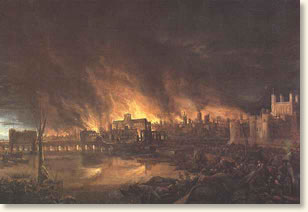
Let us see the hand of the Lord in this recent dreadful fire
which has turned our once renowned London into a ruinous
heap! London's sins were now so great, and God's wrath
was now so hot—that there was no quenching of the furious
flames. The decree for the burning of London was now gone
forth, and nothing could reverse it. The time of London's fall
was now come. The fire had now received its commission
from God—to burn down the city and to turn it into a
ruinous heap!

Certainly God is the great agent in all those dreadful
judgments which befall people, cities, and kingdoms.
Whoever or whatever be the rod—it is God's hand
which gives the stroke! The power of bringing
judgments upon cities, God takes to Himself, "When
disaster comes to a city, has not the Lord caused
it?" Amos 3:6. Whatever that judgment is, which falls
upon a city—God is the author of it; He acts in it and
orders it according to His own good pleasure. There
is no judgment which accidentally falls upon any
person, city, or country. Every judgment is inflicted
by a divine power and providence. God had given a
commission to the fire—to burn with that force and
violence as it did—until London was laid in ashes!
Whoever kindled this fire—God blew the coal!
And therefore no arts, counsels, or endeavors of
men were able to quench it.

All judgments are at the beck of God, and under the
command of God. Whatever judgment God commands
to destroy a person, a city, or country—that judgment
shall certainly and effectually accomplish the command
of God—in spite of all that creatures can do. If God
commissions the sword of war to walk abroad, and to
glut itself with blood—who can command it into the
scabbard again? No art, power, or policy can cause
that sword to lie still!

God, as He is our Creator, Preserver, and sovereign
Lord—has an absolute power both over our persons,
lives, estates, and habitations: and when we have
transgressed His righteous laws, He may do with
us, and all we have—as He pleases. He may turn
us out of house and home, and burn up all our
comforts round about us—and yet do us no wrong.
"Our God is in heaven; He does whatever pleases
Him." Psalm 115:3. "The Lord does whatever
pleases Him—in the heavens and on the earth,
in the seas and all their depths." Psalm 135:6

Those things which seem accidental and chance to
us—are ordered by the wise counsel, power, and
providence of God. Instruments can no more stir
until God gives them a commission—than the axe
or the knife can cut by itself, without a hand. God
makes use of whatever second causes He pleases,
for the execution of His pleasure. And many times
He makes the worst of men the rod of His indignation
to chastise His people with! All inferior or subordinate
causes—are but God's tools and instruments,
which He rules and guides according to His own will,
power, and providence.

Job eyed God in the fire which fell from heaven, and
in all the fiery trials which befell him. And therefore,
he does not say, "The Lord gave—and the devil took
away!" Nor, "The Lord gave—and the Chaldeans and
Sabeans took away!" But "The Lord gave—and the
Lord has taken away; may the name of the Lord
be praised!" Job 1:20-21

Certainly without the cognizance and concurrence of
a wise, omniscient, and omnipotent God—no creatures
can move. Without His foresight and permission—no
event can befall any person, city or country. Whatever
the means or instruments of our misery are—the hand
is God's! It behooves us, in every judgment, to see the
hand of the Lord, and to look through visible means to
an invisible God! "The Lord has afflicted me; the
Almighty has brought misfortune upon me!" Ruth 1:21

"The Lord brings death and makes alive; He brings
down to the grave and raises up. The Lord sends
poverty and wealth; He humbles and He exalts!" 1 Samuel 2:6-7

============


************

RELATED


God's sword!

The eye of Divine Providence

(Letters of John Newton)
"Not even a sparrow, worth only half a penny, can fall to the ground apart from the will of your Father! And the very hairs on your head are all numbered!" Matthew 10:29-30

Let us learn to see and acknowledge God's hand in all we have, and in all we meet with. Such a deep and abiding persuasion of the Most High God, ordering and over-ruling all our concerns, wouldlike the lightdiffuse a luster and a beauty upon everything around us! To consider every comfort of life, as an effect and proof of God's mercy towards us, would, like the fabled magic stoneturn all our possessions to gold, and stamp a value upon things which a common eye might judge as insignificant.

The eye of Divine Providence is upon every flitting sparrow of the field. Nor can we properly term any circumstance of our lives assmall, since such things as seem most trifling in themselves, do often give birth to things which become most important. On the other hand—to be able to discover the wisdom and goodness of our heavenly Father, through the darkest cloud of troubles and afflictions; to see all our trials appointed to usin number, weight, and measure; nothing befalling us by chance; nothing without a needs-be; nothing without a support; nothing without a divinely designed advantagewhat a support must this be to the soul!

Take away this truth of Divine Providence—and man is the most forlorn, helpless and miserable object in the world! He would be pining for everything he has not—and trembling for everything he hasHe would be equally suffering under the pressure of what doeshappenand the fear of what may happen! He would be liable to thousands of unsuspected dangersyet unable to guard against those which are most obvious!

Let us learn the secret of being content in any and every situation, "Our heavenly Father knows what we have need of, before we askHim!" "The earth is His, and the fullness thereof;" and His goodness is equal to His power.

In Christ, He has already given us more than ten thousand worlds!

Are you poor? Be satisfied with the Lord's appointment. It would be as easy to Him to give you a large estateas to supply you with the bread you eat, or to continue the breath in your nostrils. He sees that poverty is best for youHe sees that prosperity might prove your ruin! Therefore He has appointed you the honor of being in this respect, conformable to your Lord, who, when on earth, "had nowhere to lay His head!"


God's sword!

The Great Fire of London, 1666


(William Dyer, "Christ's Voice to London". Preached in London during the time of the 'Great Plague' of 1665-1666. The 'Great Plague' was a massive outbreak of disease, which killed an estimated 100,000 people, 20% of London's population.)

"Listen! The Lord is calling to the city—Hear the rod and the One who appointed it!" Micah 6:9

Oh, London, London! God speaks to you by His judgments! Because you would not hear the voice of His Word—He has made you to feel the stroke of His rod! Oh, great city! how has the plague broken in upon you, because of your abominations! "They provoked the Lord to anger by their wicked deeds—so a plague broke out among them!" Psalm 106:29. Oh! how is the wrath of God kindled against you, that such multitudes of thousands have died within your borders, by this severe plagueGod's sword! 

London! how are your streets thinned, your widows increased, and your cemeteries filled, yourinhabitants fled, your trade decayed! Oh! therefore lay to heart all these things, and turn from your wicked ways, that the cry of your prayers—may outcry the cry of your sins! Be like the city of Nineveh, who believed Jonah's message from God, and humbled themselves, and fasted and cried mightily unto the Lord. Oh, Did Nineveh repent and turn from their wicked ways—and shall notLondon? 

Perhaps you think that all is now well, and that God is pleased with you, because the plague is abating. I say, blessed be God for this! But "Do not be deceived: God cannot be mocked. Whatever a man sows—that he shall reap!" Galatians 6:7. To whomever God bestows great mercies, if they abound in great wickedness, He will inflict great punishments upon them! Alas! beloved, theplague abates—but your sins increase! There is no turning from sin—nor turning to God! There is no reformation and amendment of life among you! If this is so—then God is not done afflicting you!

If you remain . . .
  as profane as before,
  as superstitious as before,
  as carnal as before,
  as lukewarm as before,
  as hard-hearted as before,
  as proud and vain as before,
  as worldly as before; 


I say, if it is thus with you, God is not yet done with London—but has other judgments to pour out upon you, though He now causes the plague to cease. 


(Editor's note: Shortly after the writing of the above, in September of 1666, the 'Great Fire of London' gutted the city, and consumed 13,200 houses. The social and economic problems created by this disaster were overwhelming.)


link

**********
RELATED


God's tools and instruments.


Wednesday, December 29, 2010

Spurgeon Sermon - Instability

Jesus


Jesus!

(Octavius Winslow, "Evening Thoughts")

What is our path to glory, but the path of
tribulation, of suffering, and of death? Our
Lord and Master, in the expression of His
wisdom and love, forewarns us of this: "In
the world you shall have tribulation."

What are all the supports of the believer in
seasons of trial, suffering, and bereavement,
but so many manifestations of the life of the
Lord Jesus? This it is that keeps the soul . . .
buoyant amid the billows,
strong in faith,
joyful in hope,
soaring in love.

Thus is Jesus . . .
the life of every grace,
the life of every promise,
the life of every ordinance,
the life of every blessing.

Yes, of all that is really costly and
precious to a child of God, Jesus is . . .
the substance,
the glory,
the sweetness,
the fragrance,
yes, the very life itself!

Oh! dark and lonely, desolate and painful indeed
would our present pilgrimage be, but for Jesus!

If in the world we have tribulation; in
whom do we have peace? In Jesus!

If in the creature we meet with fickleness and
change; in whom do we find the Friend who loves
at all times? In Jesus!

When adversity comes as a wintry blast, and
lays low our comforts; when the cloud is upon
our tabernacle; when health, and wealth, and
influence, and friends are gone; in whom do
we find the covert from the wind, the faithful,
tender Brother born for adversity? In Jesus!

When temptation assails,
when care darkens,
when trial oppresses,
when bereavement wounds,
when heart and flesh are failing;
who throws around us the protecting shield,
who applies the precious promise,
who speaks the soothing word,
who sustains the sinking spirit,
who heals the sorrow,
who dries the tear? Jesus!

Where sin struggles in the heart, and guilt
burdens the conscience, and unbelief beclouds
the mind; whose grace subdues our iniquities,
whose blood gives us peace, and whose light
dispels our darkness? Jesus!

And when the spark of life wanes, and the
eye grows dim, and the mind wanders, and
the soul, severing its last fetter, mounts
and soars away, Jesus, in that awful moment,
draws near in form unseen, and whispers in
words unheard by all but the departing one,
now in close communion with the solemn
realities of the invisible world, "Fear not;
I am the resurrection and the life. He who
believes in Me will live, even though he dies!"

Tuesday, December 28, 2010

Glory at the End


by T. Austin-Sparks


Reading: Haggai 2:1-9; Ephesians 3:20,21; Revelation 21:10-11.


"The latter glory of this house shall be greater than the former."
"Unto him be the glory in the church... for ever and ever."
"The holy city Jerusalem, coming down out of heaven from God, having the glory of God."


It is something of which we should remind ourselves continually, that the end is going to be in glory, with glory - the end will be glory. Sometimes our answer to an interrogation might very well be that of the people in the time of Ezra, Nehemiah and Haggai: The present glory is nothing! but "the latter glory... shall be greater than the former". The end will be with glory. We must tell ourselves that, when things look anything but glorious, when the glory seems to be entirely hidden, when there seems to be no glory at all in our experience and we are passing through a deep and terrible time of trial and affliction, this is not the end; it just cannot be the end. Though we think the end has come, it cannot be identified as the end, because the Word of God says that the end is glory. This is not glory; therefore it cannot be the end and we have not arrived at the end yet. We are not going down in shame, in dishonour, in reproach, in despair. We are going up in glory, for the end is glory.


The Glory of Grace


What is this glory? Well, quite clearly, according to these passages which we have read, and others, it is the glory of grace. "The latter glory of this house shall be greater than the former", and in that very connection the prophet says: "He shall bring forth the top stone with shoutings of Grace, grace unto it" (Zechariah 4:7). The words from the letter to the Ephesians - "unto him be the glory in the church" - are set in a whole encompassment of grace. The incomparable words concerning grace are found in that letter: "That we should be... to the praise of the glory of his grace, which he freely bestowed on us in the Beloved" (1:6); "According to the riches of his grace" (1:7); "(By grace have ye been saved) ... that in the ages to come he might show the exceeding riches of his grace" (2:5,7); "Unto me", says the Writer, "was this grace given, to preach among the Gentiles the unsearchable riches of Christ" (3:8). The last words concerning grace are in connection with the glory. So it is quite obviously the glory of grace. The Lord, in order to get the glory, will see that everything is kept on a basis of grace, that is, that everything that is not grace will be smitten hip and thigh by Him. In the end there will be no other element whatever in the situation. We shall just have to say it is His grace - the glory of His grace.


The Battleground of Grace


The enemy is always trying to get us off the ground of grace. If he cannot do so by accusation, he will do so by false grace, which is presumption. In this way he makes grace a way of living as you like. It does not matter what you do, how you behave, grace will cover anything. "Once in grace, always in grace", so do not be troubled with responsibility. So grace is subverted. In many ways grace is a battleground, not a playground.


Grace a Power in the Life


The only answer to these things is this: That while grace is that favour of God which asks for no merit, no earning, and is freely bestowed on us, as Paul says, in the Beloved, grace is also a power in the life. It is a vital force to make us live according to the good pleasure of God, the grace of God not only manifested in our acceptance, but in our lives, the acceptance begetting a response to the pleasure of God. Grace is a character, a nature, as well as a standing; grace unto glory, His glory, primarily the glory of what grace has done in our acceptance, in our standing, in our position, but also what grace has done in conforming us to the image of His Son, what grace is doing in us. It is a working thing. The glory of His grace at the end will be the manifestation of what grace has done.


Monday, December 27, 2010

The Way to Victory: Joshua


The time had come for the people of Israel to enter into the land of promise. All those who left Egypt some 40 years before had perished in the wilderness, except for Caleb and Joshua. A new generation had grown up in the wilderness journey. Moses had fully instructed them in the laws and the sacrifices before he died, and Joshua had assumed the task of leading the people into the land.

Moses, the great lawgiver, was not permitted to take the people into the fulfillment of promise; rather Joshua (whose Hebrew name is the equivalent of the Greek name, Jesus) is given that privilege. This is surely an anticipation of the New Testament truth that the law cannot fulfill the promises of God, but they are all available to us through our heavenly Commander, Jesus.

Nevertheless, Joshua was instructed in the use of the law as necessary for meditation and a guideline to obedience. But the strength by which it shall be fulfilled lies in the great word, " Be strong and courageous! Do not tremble or be dismayed, for the Lord your God is with you wherever you go" (Josh. 1:9).

VICTORY IS POSSIBLE

After reminding the tribes of Reuben, Gad and the half tribe of Manasseh of their promise to assist their brethren in the conquest of the land, Joshua sent out his spies to view the situation. These go out as he himself went out, 38 years before, in confidence and faith that God intended to give them the land. They were simply attempting to see how that deliverance will be brought about. With boldness they entered into the city of Jericho and were hidden in the house of Rahab, the harlot, who informed them that the people had for 40 years been afraid of the Israelites, having heard of their miraculous deliverance at the Red Sea and their conquest of the two Amorite kings, Sihon and Og. The giants which Israel feared at Kadesh-Barnea had themselves been afraid of the people of Israel for the whole 40 years' wandering!

Rahab's personal confidence that the God of Israel was the Lord of all the earth led her to hide the two spies and aid in their subsequent escape from the city, after having them promise that when the city fell she and her household would be spared.

Forsake Unbelief

After the spies returned, Joshua ordered the people to assemble for the crossing of the Jordan. The Ark of the Covenant leading the way would show the people that a living God was among them as He opened a way through the Jordan, just as He had once opened a way through the Red Sea.

Twelve men were chosen, one from each tribe, to memorialize the occasion. As the feet of the priests touched the edge of the Jordan, the waters began to recede, having been cut off far upstream near the little city of Adam.

The priests bearing the Ark of the Covenant remained in the middle of the river until all the people passed through. Then a monument of 12 stones was erected in the middle of the river and another similar monument at the river's edge. These were to be a memorial for the children to see, that they might ask and receive an explanation from their parents.

As we seek the significance of this event in the Christian life, we must remember that just as the crossing of the Red Sea meant the willingness to forsake the world typified by Egypt, so the crossing of the Jordan indicates a willingness to enter into all the promises which God has given the believer in Jesus Christ. It acknowledges the choice to forsake the unbelief of the wilderness and to fully lay hold of all that God has made available.

Some have seen in the two memorial monuments the Christian ordinances of baptism and the Lord's Supper, and surely these are designed as memorials to remind us of the basis upon which all of God's mighty promises rest. They too need to be explained to children so that they understand their full import.


Sunday, December 26, 2010

We shall leave this staff at heaven's door

(Thomas Watson , "A Divine Cordial" 1663)

Love is the most abiding grace. This will stay with us,
when other graces take their farewell. In heaven we
shall need no repentance—because we shall have no
sin. In heaven we shall not need patience—because
there will be no affliction. In heaven we shall need no 
faith
—because faith looks at unseen things (Heb. 11:1).
Then we shall see God face to face; and where there is
vision, there is no need of faith.

But when the other graces are out of date—love continues.
And in this sense the apostle says that love is greater than
faith or hope—because it abides the longest. "Love will last
forever!" (1 Cor. 13:8). Faith is the 'staff' which we walk
with in this life. "We walk by faith" (2 Cor. 5:7). But we
shall leave this staff at heaven's door
—and only 'love'
shall enter. Thus love carries away the crown from all the
other graces. Love is the most long-lived grace—it is a
blossom of eternity. How should we strive to excel in this
grace, which alone shall live with us in heaven, and shall
accompany us to the marriage supper of the Lamb!


link

A great hospital


"All of you will desert Me," Jesus told them.
     Mark 14:27

(J. C. Ryle, "The Gospel of Mark" 1857)

We see in this verse, how well our Lord foreknew
the weakness and infirmity of His disciples. He
tells them plainly what they were going to do.
"All of you shall desert Me."

Let us take comfort in the thought that the
Lord Jesus does not cast off His believing
people because of failures and imperfections.

He knows what they are.

He takes them, as the husband takes the wife, with
all their blemishes and defects
, and, once joined to
Him by faith, will never leave them. He is a merciful
and compassionate High priest. It is His glory to pass
over the transgressions of His people, and to cover
their many sins.

He knew what they were before conversion:
wicked, guilty, and defiled; yet He loved them.

He knows what they will be after conversion:
weak, erring, and frail; yet He loves them.

He has undertaken to save them, notwithstanding
all their shortcomings. And what He has undertaken
He will perform.

Let us learn to pass a charitable judgment on the
conduct of professing believers. Let us not set them
down in a low place, and say they have no grace,
because we see in them much weakness and
corruption
. Let us remember that our Master in
heaven bears with their infirmities, and let us try
to bear with them too.

The Church of Christ is little better than a great
hospital
. We ourselves are all, more or less, weak,
and all daily need the skillful treatment of the
heavenly Physician. There will be no 'complete
cures' until the resurrection day.


link

Saturday, December 25, 2010

The counsel of the wicked

(Arthur Pink, "The Blessed Man")


Conversion is the soul's surrender to God, and acceptance of God—as Guide through this world of sin.

"Blessed is the man who does not walk in the counsel of the wicked.
" Psalm 1:1

Notice exactly how this is expressed—it is not "does not walk in the open wickedness" nor even "the manifest folly of the wicked," but "does not walk in the counsel of the wicked." How searching that is! How it narrows things down!

The ungodly are ever ready to "counsel" the believer, seeming to be very solicitous of his welfare. They will warn him against being too strict and extreme, advising him to be broad-minded and to "make the best of both worlds." But the policy of the "ungodly"—that is, of those who leave God out of their lives, who have no "fear of God"—is regulated by self-will and self-pleasing, and is dominated by what they call "common sense."

Alas, how many professing Christians regulate their lives by the advice and suggestions of ungodly friends and relatives—heeding such "counsel" in their business career, their social life, the furnishing and decorating of their homes, their dress and diet, and the choice of school or avocation for their children!

But not so with the "blessed man." He "does not walk in the counsel of the wicked." Rather is he afraid of it, no matter how plausible it sounds, or apparently good the intention of those who offer it. He shuns it, and says "Get behind me, Satan!"

Why? Because Divine grace has taught him that he has something infinitely better to direct his steps. God has given him a Divine revelation, dictated by unerring wisdom, suited to his every need and circumstance, designed as a "lamp unto his feet and a light unto his path." His desire and his determination is to walk by the wholesome counsel of God, and not by the corrupt counsel of the ungodly.

The "blessed man" does not walk according to the maxims of the world. "But his delight is in the Law of the Lord." "The carnal mind is enmity against God, for it is not subject to the Law of God" (Romans 8:7). The worldling seeks his "delight" in the entertainment furnished by those who scorn spiritual and eternal things. Not so the "blessed" man—his "delight" is in something infinitely superior to what this perishing world can supply, namely, in the Divine Scriptures. The unregenerate delight in pleasing self—but the joy of the Christian lies in pleasing God. His Word is the daily bread of the "blessed" man.

"And in His Law, he meditates day and night" (Psalm 1:2). Thereby does he evidence his "delight" therein—for where his treasure is, there is his heart also! Here, then, is the occupation of the blessed man. The voluptuary thinks only of satisfying his senses; the giddy youth is concerned only with sports and pleasures; the man of the world directs all his energies to the securing of wealth and honors; but the "blessed" man's determination is to please God, and in order to obtain a better knowledge of His will, he meditates day and night in His holy Word. Thereby is light obtained, its sweetness extracted, and the soul nourished!

"Your Words were found, and I ate them; and Your Word was unto me the joy and rejoicing of my heart!" (Jeremiah 15:16). Meditationstands to reading—as digestion does to eating. It is as God's Word is pondered by the mind, turned over and over in the thoughts, and mixed with faith—that we assimilate it. That which most occupies the mind and most constantly engages our thoughts—is what we most "delight" in.

"He is like a tree planted by streams of water, which yields its fruit in season." Fruit is an essential character of a gracious man, for there are no fruitless branches in the true Vine. "In season," for all fruits do not appear in the same month, neither are all the graces of the Spirit produced simultaneously.
Times of trial—call for faith.
Times of suffering—call for patience.
Times of disappointment—call for meekness.
Times of danger—call for courage.
Times of blessings—call for thanksgiving.
Times of prosperity—call for joy.

How far, dear reader, do you resemble this "blessed man"?


link

Some Delilah

(Thomas Brooks)


There is some Delilah—some darling, some beloved sin 
or other—that a Christian's calling, condition, constitution,
or temptations—leads him to play with, and to hug in his
own bosom.

As in a plot of ground which lies untilled, among the great
variety of weeds, there is usually some master-weed, that
is more plenteous and more repulsive than all the rest.

So it is also in the souls of men—though there is a general
mixture and medley of all evil and corrupt qualities
; yet
there is some one sin which is usually paramount, which is most
powerful and prevalent—which sways and manifests itself more
eminently and evidently than any other of them do.

So, though the root of sin and bitterness has spread itself over
all, yet every man has his inclination to one kind of sin—rather
than another. And this may be called a man's besetting sin,
his bosom sin, his darling sin.

Now, it is one of the hardest works in this world to subdue and
bring under control, this bosom sin! Oh! the prayers, the tears,
the sighs, the sobs, the groans, the gripes that it will cost a
Christian before he subdues this darling sin!

A man may easily subdue and mortify such and such sins; but
when it comes to the master-sin, to the bosom-sin, oh! what
tugging and pulling is there! what striving and struggling is
there to get off that sin, to get down that darling sin!

Now, if the Lord, by smiting you in some near and dear
enjoyment, shall draw out your heart to fall upon the smiting
of your master-sin; and shall so sanctify the affliction, as to
make it issue in the mortification of your bosom corruption;
what eminent cause will you have rather to bless Him, than
to sit down and murmur against Him! And doubtless if you
are dear to God—God will, by striking your dearest mercy,
put you upon striking at your darling sin! Therefore do not
murmur, even when God touches the apple of your eye;
even when He has snatched the fairest and the sweetest
flower out of your bosom!


link


Surely something must be amiss with the scales!

(Charles Spurgeon)


"You are to have honest balances, honest weights, an honest dry measure, and an honest liquid measure; I am the Lord your God, who brought you out of the land of Egypt." Leviticus 19:36

Weights, and scales, and measures—were to be all according to the standard of justice.

Surely no Christian will need to be reminded of this in his business, for if justice were banished from all the world beside—it should find a shelter in true Christian hearts!

There are, however, other scales and balances which weigh moral and spiritual things—and these often need examining. We will call in theJudge right now.

Those scales in which we weigh our own and other men's characters—are they quite accurate? Do we not turn our own ounces of goodness—into pounds; and other people's pounds of excellence—into ounces? See to just weights and measures here, Christian!

Those scales in which we measure our trials and troubles—are they according to standard? Paul, who had far more to suffer than we have—called his afflictions light. Yet we often consider our afflictions to be heavy! Surely something must be amiss with the scales! We must see to this matter, lest we get reported to the court above, for unjust dealing!

Those scales with which we measure our beliefs—are they quite fair? The precepts and doctrines should have the same weight with us as the promises—no more and no less! With many, one scale or the other is unfairly weighted. It is a grand matter to give just measure in God's truths. Christian, be careful here!

Those scales in which we estimate our obligations and responsibilities look rather small. When a rich man gives no more to the cause of God, than the poor contribute—is that an honest weight, an honest measure, a just balance?

Reader, we might lengthen the list—but we prefer to leave it as your day's work—to find out and destroy all unjust scales, balances, weights, and measures!


link

Thursday, December 23, 2010

Matthew 13:31-35

31Another parable put he forth unto them, saying, The kingdom of heaven is like to a grain of mustard seed, which a man took, and sowed in his field:

32Which indeed is the least of all seeds: but when it is grown, it is the greatest among herbs, and becometh a tree, so that the birds of the air come and lodge in the branches thereof.

33Another parable spake he unto them; The kingdom of heaven is like unto leaven, which a woman took, and hid in three measures of meal, till the whole was leavened.

34All these things spake Jesus unto the multitude in parables; and without a parable spake he not unto them:

35That it might be fulfilled which was spoken by the prophet, saying, I will open my mouth in parables; I will utter things which have been kept secret from the foundation of the world.

Wednesday, December 22, 2010

Seeking God's Will


1 Samuel 30:1-8, 18-26

When David and his men found Ziklag burned with fire and their wives and their children gone, they wept. This was a bitter blow to all of them. David in particular, however, tasted the bitterness of being without God's protection. He had been miraculously taken care of on many other occasions, but now that protection had been removed for the time being. David had exchanged the king of Gath and a walled city for the Spirit of the Lord and found no protection in man. It is the Spirit of the Lord who protects God's people. How often we forget this.

      Some of us might be inclined to think that the normal thing would have been for David to start out after the Amalekites without even asking the Lord about it. We might think this was the obvious thing to do. But remember, David had had enough of his own reasoning. He had followed his own reasoning in going to Gath and by it had escaped from the hand of Saul, but he got himself into more difficulties than he ever expected. The seemingly natural thing to do may not always be the right thing as far as God is concerned. When David's fellowship with the Lord was restored, he let the Lord guide his steps.

      God's Word admonishes us: "Trust in the Lord with all thine heart; and lean not unto thine own understanding" (Prov. 3:5). David sought God's will, and God eventually gave victory.
      "But who so hearkeneth unto me shall dwell safely, and shall be quiet from fear of evil" (Prov. 1:33).

THE BEATIFIC VISION

MATTHEW 5:8


(
John MacDuff, "The Words of Jesus")

"Blessed are the pure in heart, for they shall see God!" Matthew 5:8

Here is Heaven! This promise of Jesus represents the future state of the glorified to consist not in locality — but in character; the essence of its bliss is the full vision and fruition of God! Our attention is called away from all vague and indefinite theories about the circumstantials of future happiness. The one grand object of contemplation, the "glory which excels" — is the sight of God Himself! The one grand practical lesson enforced on His people, is the cultivation of that purity of heart, without which none could see, or (even could we suppose it possible to be admitted to see Him) none could enjoy God!

What will Heaven be — but the entire surrender of the soul to Him, without any bias to evil, without the fear of corruption within, echoing to temptation without; every thought brought into captivity to the obedience of Christ; no contrariety to His mind; all in blessed unison with His will! And the whole being, impregnated with holiness:
the intellect — purified and ennobled, consecrating all its powers to His service;
the memory — a holy repository of pure and hallowed recollections;
the affections — without one competing rival, purged from all the dross of earthliness;
the love of God — the one supreme animating passion;
the glory of God — the motive principle interfused through every thought, feeling, and action of the life immortal!
In one word, the heart a clear fountain — no sediment to dim its purity!

Yes, this is Heaven: purity of heart — and "God all in all!" Much, doubtless, there may and will be of a subordinate kind, to intensify the bliss of the redeemed: communion with saints and angels; re-admission into the society of death-divided friends. But all these will fade before the great central glory: "God Himself shall be with them, and be their God! They shall see His face!"

Believers have been aptly called 'sunflowers' — turning their faces as the sunflower, towards the Sun of Righteousness; and hanging their leaves in sadness and sorrow — when that Sun is away. It will be in Heaven, that the emblem is complete. There, every flower in the heavenly garden will be turned God-wards, bathing its tints of loveliness in the all-excelling glory of God! Reader, may it be yours, to know all the marvels contained in these few glowing words, "We shall be like Him — for we shall see Him as He is!" "I shall be satisfied — when I awake with Your likeness!"
"And every man who has this hope in Him — purifies himself, even as He is pure."

~  ~  ~  ~  ~


Pride and Its Undoing by T. Austin-Sparks


If I were asked to choose a text for what is on my heart I should have very great difficulty. I can only say to you that the whole Book is the text, so I give you the whole Bible as my text, and what I have on my heart I am going to present, in the first place, in the form of three propositions or questions.


Firstly: If there was one particular thing that was the cause of all the suffering, the misery, the trouble, the distress, the wars, and the necessity for God to stand back in reserve; would we not wish with all our being to be saved and delivered from that thing? There is such a thing, and I am quite sure that, if it really did come home to us that all that I have mentioned, and much more, from the beginning until now and to the end, was related to and bound up with that one thing, your answer to my question would be, 'The Lord save me from that! With all my heart, with all my being, I do seek to be delivered from that!" I am sure you agree.


Secondly: If there was one thing that gave God the ground for being toward us, free from fear and free from reserve on His part, so that His purposes could be realised, His power be released, His wisdom be active, fellowship with Him be unclouded, and His glory be resultant from our having been here on this earth; would we not with all our heart and with all our being say, 'Let that be in me!'? We certainly would be in very earnest and whole-hearted quest for that, would we not?

The Love from which Righteousness Springs by Alan Martin


Jesus was asked once “Teacher, which is the great commandment in the Law?” Jesus answered by saying “You shall love the Lord your God with all your heart, with all your soul, and with all your mind. This is the first and great commandment. And the second is like it: You shall love your neighbor as yourself. On these two commandments hang all the Law and the Prophets.” If the entire Law and the Prophets are hanging upon the love of God and the love of our neighbor, there will be no ability to fulfill the Law or the words of the prophets if there is a deficiency in love on which the two depend. If what the Law and the Prophets are hanging upon breaks, then they both come crashing to the ground. The weaker hangs upon the stronger – therefore love is greater than Law.


Paul’s understanding is hand in hand with our Lord’s as seen in Galatians 5:6 “For in Christ Jesus neither circumcision nor uncircumcision avails anything, but faith working through love.” Paul was referring to the only means to fulfill the true righteousness of God. In the same chapter Paul wrote “For all the Law is fulfilled in one word, even in this: You shall love your neighbor as yourself.” Paul explains this in greater detail in his letter to Roman 13:9-10 “For the commandments, you shall not commit adultery, you shall not murder, you shall not steal, you shall not bear false witness, you shall not covet, and if there is any other commandment, are all summed up in this saying, namely, you shall love your neighbor as yourself. Love does no harm to a neighbor; therefore, love is the fulfillment of the law.” The only way the righteousness of the Law will be fulfilled in our lives is through the love of God being shed abroad in our hearts by the Holy Spirit – this is the hope we await by faith.

Sunday, December 12, 2010

Sent from God – Isaiah's call


by Art Katz


In the year that king Uzziah died I saw the Lord sitting upon a throne, high and lifted up; and His train filled the temple.
Above Him stood the seraphim: each one had six wings; with twain he covered his face, and with twain he covered his feet, and with twain he did fly.  And one cried unto another, and said, “Holy, holy, holy, is Jehovah of hosts: the whole earth is full of his glory.”
And the foundations of the thresholds shook at the voice of Him that cried, and the house was filled with smoke.
Then said I, “Woe is me! For I am undone; because I am a man of unclean lips, and I dwell in the midst of a people of unclean lips: for mine eyes have seen the King, Jehovah of hosts.”
Then flew one of the seraphim unto me, having a live coal in his hand, which he had taken with the tongs from off the altar: and he touched my mouth with it, and said, “Lo, this hath touched thy lips; and thine iniquity is taken away, and thy sin forgiven.”
And I heard the voice of the Lord, saying, “Whom shall I send, and who will go for us?”
Then I said, “Here am I; send me.”
And He said, “Go, and tell this people, ‘Hear ye indeed, but understand not; and see ye indeed, but perceive not.’  Make the heart of this people fat, and make their ears heavy, and shut their eyes; lest they sea with their eyes, and hear with their ears, and understand with their heart, and turn again, and be healed.”
Then said I, “Lord, how long?” And He answered, “Until cities be waste without inhabitant, and houses without man, and the land become utterly waste, and Jehovah has removed men far away, and the forsaken places be many in the midst of the land.  And if there be yet a tenth in it, it also shall in turn be eaten up: as a terebinth, and as an oak, whose stock remaineth, when they are felled; so the holy seed is the stock thereof” (Isaiah 6:1-13)
Too many of us have been guilty of lightly dismissing this account as an unimportant mystic vision of a God who is in some kind of hyper-state of glory.  Why then did it affect the prophet so radically?  My own suggestion is that the prophet saw the King in the greatest moment of His majesty.  In other words, God chose to express His deepest essence and being in a moment of time in the life of Isaiah, and that anyone who would contemplate that moment rightly will be altogether devastated and undone.  With that in mind, I am led to believe that Isaiah saw the crucifixion of the King, because nothing reveals the majesty of God more than in the depth of His suffering, experienced and borne for us as atonement!  You may ask how Isaiah could have seen the crucifixion of Jesus six or seven centuries before the actual event.  Let us not forget that the Lord was “slain from before the foundations of the earth were laid.” 
This is not just a chance episode in the life of the prophet; it is the unfolding of a remarkable pattern; a sequence of events by which the prophet, who already had a ministry, and was already cautioning and warning the nation of its sin from the very first chapter of his book, now enters a new dimension.  His subsequent ministry as one sent was no longer merely to warn or to caution, but to judge.  His word would now constitute judgment: Israel will not hear, will not see, and their hearts will be dulled because the prophet has spoken to them in a new depth of urgency, weight and authority as one sent.
How many of us have sufficiently dwelt on the word sent as we ought?  Do we understand the significance of the difference between one who went and the one who is sent?  However well-meaning it might be, is not most of our Christian activity self-initiated or committee determined?  Do we know, and I mean really know, what it is to be sent from the One who is enthroned? 
How many of us have a self-motivated itch to go and to do, and to cut a swathe for ourselves and our ministry?  How many sendings are there of the kind that initiated the early history of the church?  Those that were sent turned the world upside-down.  Do we sufficiently honor and esteem the phenomenon of sending?  Do we understand the difference between the consequences of the work that results from one sent in comparison to the work of one who is self-initiated in his going?  Are we even assured that the world needs to be turned upside-down?  Or do we see the world as needing merely to be modified and have some of its excesses reduced?  Do we see the world as being evil?  Are we chafed by its immorality?  
Everything hinges upon seeing the Lord as the Lord.  My greatest grief over the condition of the church, its leadership and its prominent ministers is that they do not know God as God to any significant degree; they do not know Him as He in fact is.  Without this knowledge of God, we are condemned to a hollow counterfeit much more in harmony with our own approving ambition and intentions.  Consequently, there is no fear of God, and we will find ourselves taking liberties and initiating conduct that was not sent from heaven.  Everything rests on seeing the Lord high and lifted up and enthroned in His majestic glory, but brought to perfection in the moment of His most excruciating suffering at Calvary.  That is what this prophet saw, and he cried out “I am undone!  I am a man of unclean lips!”

EXCHANGED LIFE by Major W. Ian Thomas

Christian living is not a method or technique; it is an entirely different, revolutionary principle of life. It is the principle of an exchanged life" not I, but Christ liveth in me" (Galatians 2:20).

This is all part of our Gospel - it is not the Gospel plus! We must not get our terminology wrong. To divorce the behavior of the Christian from the Gospel is entirely false and is not true to the Word of God, yet all too often such is the characteristic of gospel preaching.

I would like to explore with you what is the true spiritual content of our Gospel ­ not just heaven one day, but Christ right now! Christ in you, on the grounds of redemption ­ this is the Gospel! To preach anything less than this must inevitably produce "Evan-jellyfish" ­ folk with no spiritual vertebrae, whose faith docs not "behave!"

Do you remember what James says in his epistle? "As the body without the spirit is dead, so faith without works is dead" (chapter 2:26). The "spirit" there means breath, and a body without breath is dead. Stop breathing ­ and folk will bury you! In other words, a living body breathes, and a living faith breathes, and a living faith breaths with divine action. A living faith breathes with the activity of Jesus Christ. That is why the Lord Jesus, in John 6:29, said, "This is the work of God, that ye believe on Him whom He hath sent."

That is the work of God. It is your living faith in the adequacy of the One who is in you, which releases His divine action through you. It is the kind of activity that the Bible calls "good works," as opposed to "dead works."

"Good works" are those works that have their origin in Jesus Christ - - whose activity is released through your body, presented to Him as a living sacrifice by a faith that expresses total dependence, as opposed to the Adamic independence (Romans 12: 1,2).

It is only the life of the Lord Jesus -- His activity, clothed with you and displayed through you, that ultimately will find the approval of God.

link

The Person of the Holy Spirit -Eli Brayley


 The Person of the Holy Spirit

"Can two walk together, except they be agreed?" - Amos 3:3


Many Christians today haven't a clue who the Holy Spirit is. This is simply because they have never been introduced. I am not suggesting they have never come in contact with the Holy Spirit, or else they would surely not be Christians at all! But, just as you have never met the maker and designer of the shirt you wear, so many believers, though having come to Christ by the working of the Spirit of God, have never had a personal aquaintance. It is my goal in this article to arrange a meeting in the most simplest way.

The first thing to understand is the fact that just as you had need to receive the Son of God, so you have need to receive the Spirit of God. "Have ye received the Holy Ghost since ye believed?" A common reason for having not received is their reply: "We have not so much as heard whether there be any Holy Ghost." (Acts 19:2) Believers as they were, they had experienced the working of the Spirit in the their lives but not the Worker Himself.


WHAT THE HOLY SPIRIT IS NOT

Vision For the Lost - William Booth


READ HERE

The Spirit


(David Harsha, "The Savior's Ascension")


The Spirit is given to supply the Savior's absence,
and to apply to our souls the redemption finished
on Calvary. It is His blessed work to glorify Jesus;
to testify of Him.

Through His power we are renewed; sanctified;
filled 'with all joy and peace in believing,' and
'abound in hope' of a blissful immortality.

The Spirit reveals the Savior to our souls in a
manner that renders Him exceedingly precious
in our estimation. He shows us....
  His excellence;
  the perfections of His divine nature, as the
    brightness of the Father's glory;
  His power, as the Creator of all things;
  His wisdom;
  His immutability;
  His eternity.

The Spirit exhibits to us....
  the amazing love of Jesus to sinners;
  the wonders of His incarnation;
  the amiableness of His life on earth;
  the spotless purity of His character;
  the unparalleled sufferings of His life;
  the fruits of His death, resurrection;
    ascension, and intercession.

The Spirit shows us His suitableness to our needs
as sinners; points us to Calvary, and whispers in
our ears the cheering truth, that we have redemption
through the blood of Jesus, even the forgiveness of sins.

The Spirit comforts us amid all the tribulations of
earth, by assuring us that our trials are but light and
momentary, by perfecting His strength in our weakness,
by bringing to our remembrance the many precious
words of the Lord Jesus, by communicating to us
the things of God, by lifting our hearts above the
world, and by pointing us to a home of rest and
glory beyond the skies; where tribulation, and
anguish, and death, never come.

Yes, by His divine power thus operating on our minds,
He enables us to look far beyond the present; to direct
faith's far reaching eye to our Father's house, and the
fountains of immortal life, flowing through those 'sweet
fields beyond the swelling flood,' the sight of which
makes us long to be there, that we may see Jesus as
He is, and taste His goodness on the shores of the
promised land.

link

Thursday, August 5, 2010

A Right Thing Done in a Wrong Way


  (1 Chronicles 13-15)


      The inclusion of this episode in the Chronicles of Israel has evidently a very definite purpose; it conveys a message which the "Israel of God" - the Church - has been, and still is, all too slow to take account of.


      Precisely, it is this. A right thing done in a wrong way can be as disastrous as either not doing it at all or even doing a wrong thing. It says beyond question that God is as jealous and particular about how a thing is done as He is about having it done at all. Let us look carefully at this tragedy.


      The Credit Side


      On the credit and good side we have


      1. The right object. There was no question whatever that the matter in hand was something right and that God wanted to be done. Eventually, when it was done in the right way, He greatly blessed it. That the homeless Ark of the Testimony should be brought a real stage nearer to its final resting-place was all in accord with the mind of God. It was really destined to have its full and final place as the focal-point of the life of the redeemed nation in Jerusalem, and so reach the end of that disorder resultant, so largely, from the man-made regime of Saul (verse 3).


      2. It was contemplated, discussed, and decided upon with reference and deference to the will of God (verse 2). That will was desired and honoured.


      3. Although the initiative and inspiration came from one man, it was a corporate decision, taken in conference and fellowship. There was no independent act of an individual (verses 2, 5).


      4. There was no lack of zeal, enthusiasm, and energy. It says that they did it "with all their might" (verse 8).


      5. The motive, good intention, sincerity, and devotion were unquestionable.


      This makes a fairly good total on the credit side: right object; the will of God desired; unity and fellowship in decision; whole-hearted zeal in committal; rightness of motive and intention. What more could be required? Are these not the things which characterize most enterprises for God? There is certainly nothing wrong with them in themselves, and no condemnation attaches to any one of those points. What more could be called for?


      And in the case under consideration, all seemed to be going well and prospering for a time. They were 'making merry before the Lord with all their might, with songs, and lyres, and harps, and tambourines, and cymbals, and trumpets' (verse 8). The seeming success up to a certain point led them to assume that the Lord was with them and that His acceptance was assured. But - Oh, woeful But! - something happened. In itself it was a simple thing and not an extraordinary happening. It was only that "the oxen stumbled". Upon that stumble in the threshing-floor of Chidon the entire scene changed. An apparently simple incident uncovered a whole lot of wrong in principle. It was well-intentioned on the part of Uzza, prompted by real concern for the Ark and its safety; a real interest in the success of the whole undertaking and enterprise. All that he did was to "put forth his hand to hold the Ark" (verse 9). It was all so natural, so spontaneous, so well-meant, so free from vice and evil desire. But "the anger of the Lord was kindled against Uzza, and he smote him... and he died there... before God" (verse 10).


      Well, we may not like it, and we may feel bad about it. That is how David felt. He was angry (verse 11). He was afraid of God (verse 12), and he said, "How can I bring up the Ark of God to me?" Looked at naturally there appears to be very good reason for being offended with the Lord; for saying, 'evidently the Lord does not want us, or our service; He does not care for all our well-meaning efforts to do what we were convinced was His will and would please Him. We had better give it up!' So David felt and acted accordingly, and the whole project came to a standstill.


Nothing More to Say


Job 40:1-5


      Job had contended with God. He had argued against God's dealing with him, which was the root of his problem. He, the creature, had sat in judgment against God, the Creator. He had even accused God of doing the wrong thing.


      Now God had spoken to Job and made His presence known. From nature He had emphasized very obvious lessons so that Job could not fail to catch the moral principles involved. No wonder Job replied that he was vile.


      How could Job really answer God after this revelation of God's care for His creatures? Job realized how contemptible he had been in speaking as he did of the Lord. He had thought the Lord cruel and unjust; in reality God had shown His love to Job. Job decided all he could do was put his hand on his mouth, say nothing more and just listen to God.
      How do we face times of suffering? Do we wonder after a long period of testing if God really cares? We seek for love and care, and God in His grace is ready and willing to love us and care for us; but above all we must remember that God has permitted this testing and has a purpose in it. God is both sovereign and righteous; therefore, He always does what is right.


      When a believer does wrong, he may suffer for the wrong done. On the other hand, much suffering in the life of a believer is for discipline, not punishment. Through such suffering God molds him into the image of His Son (see Rom. 8:28,29).

      "Now we know that what things so ever the law saith, it saith to them who are under the law: that every mouth may be stopped, and all the world may become guilty before God" (Rom. 3:19).