Friday, December 31, 2010

An excellent way of commenting upon the Bible

(Thomas Watson)

"How I love Your teaching! It is my meditation
all day long." Psalm 119:97

Chrysostom compares the Scripture to a garden,
every truth is a fragrant flower, which we should
wear, not on our bosom--but in our heart!

David counted the Word "sweeter than honey
and the honeycomb". There is that in Scripture
which may breed delight. It shows us the way . . .
to riches: Deut 28:8, Prov 3:30;
to long life, Psalm 34:42;
to a kingdom, Heb 12:28.

Well then may we count those the sweetest hours
which are spent in reading the holy Scriptures; well
may we say with the prophet, "Your words were
found, and I ate them. Your words became a
delight to me and the joy of my heart."

Conform to Scripture. Let us lead Scripture lives.
Oh that the Bible might be seen printed in our
lives! Do what the Word commands. Obedience is
an excellent way of commenting upon the Bible.
"Teach me Your way, O Lord--and I will walk in Your
truth." Let the Word be the sun-dial by which you
set your life. What are we the better for having the
Scripture--if we do not direct all our speech and
actions according to it? What are we the better for
the rule of the Word--if we do not make use of it,
and regulate our lives by it? What a dishonor is it
to religion--for men to live in contradiction to
Scripture! The Word is called a "light to our feet"
It is not only a light to our eyes to mend our sight
--but to our feet to mend our walk. Oh let us lead
Bible lives!

Be thankful to God for the Scriptures. What a
mercy is it that God has not only acquainted us
what His will is, but that He has made it known
by writing! The Scripture is our pole-star to
direct us to heaven, it shows us every step we
are to take; when we go wrong--it instructs us;
when we go right--it comforts us.

Adore God's distinguishing grace, if you have
felt the power and authority of the Word upon
your conscience; if you can say as David, "Your
word has quickened me." Christian, bless God
that He has not only given you His Word to be
a rule of holiness--but His grace to be a principle
of holiness. Bless God that He has not only written
His Word, but sealed it upon your heart, and made
it effectual. Can you say it is of divine inspiration,
because you have felt it to be of lively operation?
Oh free grace! that God should send out His Word,
and heal you; that He should heal you--and not
others! That the same Scripture which to them is
a dead letter--should be to you a savor of life!


Thursday, December 30, 2010

God's tools and instruments.


God's tools and instruments

(Thomas Brooks, "London's Lamentations" 1670)

"I form the light and create darkness, I bring prosperity
and create disaster; I, the Lord, do all these things." Isaiah 45:7

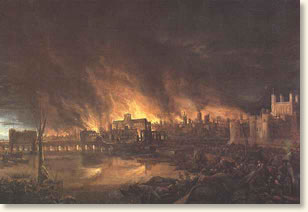
Let us see the hand of the Lord in this recent dreadful fire
which has turned our once renowned London into a ruinous
heap! London's sins were now so great, and God's wrath
was now so hot—that there was no quenching of the furious
flames. The decree for the burning of London was now gone
forth, and nothing could reverse it. The time of London's fall
was now come. The fire had now received its commission
from God—to burn down the city and to turn it into a
ruinous heap!

Certainly God is the great agent in all those dreadful
judgments which befall people, cities, and kingdoms.
Whoever or whatever be the rod—it is God's hand
which gives the stroke! The power of bringing
judgments upon cities, God takes to Himself, "When
disaster comes to a city, has not the Lord caused
it?" Amos 3:6. Whatever that judgment is, which falls
upon a city—God is the author of it; He acts in it and
orders it according to His own good pleasure. There
is no judgment which accidentally falls upon any
person, city, or country. Every judgment is inflicted
by a divine power and providence. God had given a
commission to the fire—to burn with that force and
violence as it did—until London was laid in ashes!
Whoever kindled this fire—God blew the coal!
And therefore no arts, counsels, or endeavors of
men were able to quench it.

All judgments are at the beck of God, and under the
command of God. Whatever judgment God commands
to destroy a person, a city, or country—that judgment
shall certainly and effectually accomplish the command
of God—in spite of all that creatures can do. If God
commissions the sword of war to walk abroad, and to
glut itself with blood—who can command it into the
scabbard again? No art, power, or policy can cause
that sword to lie still!

God, as He is our Creator, Preserver, and sovereign
Lord—has an absolute power both over our persons,
lives, estates, and habitations: and when we have
transgressed His righteous laws, He may do with
us, and all we have—as He pleases. He may turn
us out of house and home, and burn up all our
comforts round about us—and yet do us no wrong.
"Our God is in heaven; He does whatever pleases
Him." Psalm 115:3. "The Lord does whatever
pleases Him—in the heavens and on the earth,
in the seas and all their depths." Psalm 135:6

Those things which seem accidental and chance to
us—are ordered by the wise counsel, power, and
providence of God. Instruments can no more stir
until God gives them a commission—than the axe
or the knife can cut by itself, without a hand. God
makes use of whatever second causes He pleases,
for the execution of His pleasure. And many times
He makes the worst of men the rod of His indignation
to chastise His people with! All inferior or subordinate
causes—are but God's tools and instruments,
which He rules and guides according to His own will,
power, and providence.

Job eyed God in the fire which fell from heaven, and
in all the fiery trials which befell him. And therefore,
he does not say, "The Lord gave—and the devil took
away!" Nor, "The Lord gave—and the Chaldeans and
Sabeans took away!" But "The Lord gave—and the
Lord has taken away; may the name of the Lord
be praised!" Job 1:20-21

Certainly without the cognizance and concurrence of
a wise, omniscient, and omnipotent God—no creatures
can move. Without His foresight and permission—no
event can befall any person, city or country. Whatever
the means or instruments of our misery are—the hand
is God's! It behooves us, in every judgment, to see the
hand of the Lord, and to look through visible means to
an invisible God! "The Lord has afflicted me; the
Almighty has brought misfortune upon me!" Ruth 1:21

"The Lord brings death and makes alive; He brings
down to the grave and raises up. The Lord sends
poverty and wealth; He humbles and He exalts!" 1 Samuel 2:6-7

============


************

RELATED


God's sword!

The eye of Divine Providence

(Letters of John Newton)
"Not even a sparrow, worth only half a penny, can fall to the ground apart from the will of your Father! And the very hairs on your head are all numbered!" Matthew 10:29-30

Let us learn to see and acknowledge God's hand in all we have, and in all we meet with. Such a deep and abiding persuasion of the Most High God, ordering and over-ruling all our concerns, wouldlike the lightdiffuse a luster and a beauty upon everything around us! To consider every comfort of life, as an effect and proof of God's mercy towards us, would, like the fabled magic stoneturn all our possessions to gold, and stamp a value upon things which a common eye might judge as insignificant.

The eye of Divine Providence is upon every flitting sparrow of the field. Nor can we properly term any circumstance of our lives assmall, since such things as seem most trifling in themselves, do often give birth to things which become most important. On the other hand—to be able to discover the wisdom and goodness of our heavenly Father, through the darkest cloud of troubles and afflictions; to see all our trials appointed to usin number, weight, and measure; nothing befalling us by chance; nothing without a needs-be; nothing without a support; nothing without a divinely designed advantagewhat a support must this be to the soul!

Take away this truth of Divine Providence—and man is the most forlorn, helpless and miserable object in the world! He would be pining for everything he has not—and trembling for everything he hasHe would be equally suffering under the pressure of what doeshappenand the fear of what may happen! He would be liable to thousands of unsuspected dangersyet unable to guard against those which are most obvious!

Let us learn the secret of being content in any and every situation, "Our heavenly Father knows what we have need of, before we askHim!" "The earth is His, and the fullness thereof;" and His goodness is equal to His power.

In Christ, He has already given us more than ten thousand worlds!

Are you poor? Be satisfied with the Lord's appointment. It would be as easy to Him to give you a large estateas to supply you with the bread you eat, or to continue the breath in your nostrils. He sees that poverty is best for youHe sees that prosperity might prove your ruin! Therefore He has appointed you the honor of being in this respect, conformable to your Lord, who, when on earth, "had nowhere to lay His head!"


God's sword!

The Great Fire of London, 1666


(William Dyer, "Christ's Voice to London". Preached in London during the time of the 'Great Plague' of 1665-1666. The 'Great Plague' was a massive outbreak of disease, which killed an estimated 100,000 people, 20% of London's population.)

"Listen! The Lord is calling to the city—Hear the rod and the One who appointed it!" Micah 6:9

Oh, London, London! God speaks to you by His judgments! Because you would not hear the voice of His Word—He has made you to feel the stroke of His rod! Oh, great city! how has the plague broken in upon you, because of your abominations! "They provoked the Lord to anger by their wicked deeds—so a plague broke out among them!" Psalm 106:29. Oh! how is the wrath of God kindled against you, that such multitudes of thousands have died within your borders, by this severe plagueGod's sword! 

London! how are your streets thinned, your widows increased, and your cemeteries filled, yourinhabitants fled, your trade decayed! Oh! therefore lay to heart all these things, and turn from your wicked ways, that the cry of your prayers—may outcry the cry of your sins! Be like the city of Nineveh, who believed Jonah's message from God, and humbled themselves, and fasted and cried mightily unto the Lord. Oh, Did Nineveh repent and turn from their wicked ways—and shall notLondon? 

Perhaps you think that all is now well, and that God is pleased with you, because the plague is abating. I say, blessed be God for this! But "Do not be deceived: God cannot be mocked. Whatever a man sows—that he shall reap!" Galatians 6:7. To whomever God bestows great mercies, if they abound in great wickedness, He will inflict great punishments upon them! Alas! beloved, theplague abates—but your sins increase! There is no turning from sin—nor turning to God! There is no reformation and amendment of life among you! If this is so—then God is not done afflicting you!

If you remain . . .
  as profane as before,
  as superstitious as before,
  as carnal as before,
  as lukewarm as before,
  as hard-hearted as before,
  as proud and vain as before,
  as worldly as before; 


I say, if it is thus with you, God is not yet done with London—but has other judgments to pour out upon you, though He now causes the plague to cease. 


(Editor's note: Shortly after the writing of the above, in September of 1666, the 'Great Fire of London' gutted the city, and consumed 13,200 houses. The social and economic problems created by this disaster were overwhelming.)


link

**********
RELATED


God's tools and instruments.


Wednesday, December 29, 2010

Spurgeon Sermon - Instability

Jesus


Jesus!

(Octavius Winslow, "Evening Thoughts")

What is our path to glory, but the path of
tribulation, of suffering, and of death? Our
Lord and Master, in the expression of His
wisdom and love, forewarns us of this: "In
the world you shall have tribulation."

What are all the supports of the believer in
seasons of trial, suffering, and bereavement,
but so many manifestations of the life of the
Lord Jesus? This it is that keeps the soul . . .
buoyant amid the billows,
strong in faith,
joyful in hope,
soaring in love.

Thus is Jesus . . .
the life of every grace,
the life of every promise,
the life of every ordinance,
the life of every blessing.

Yes, of all that is really costly and
precious to a child of God, Jesus is . . .
the substance,
the glory,
the sweetness,
the fragrance,
yes, the very life itself!

Oh! dark and lonely, desolate and painful indeed
would our present pilgrimage be, but for Jesus!

If in the world we have tribulation; in
whom do we have peace? In Jesus!

If in the creature we meet with fickleness and
change; in whom do we find the Friend who loves
at all times? In Jesus!

When adversity comes as a wintry blast, and
lays low our comforts; when the cloud is upon
our tabernacle; when health, and wealth, and
influence, and friends are gone; in whom do
we find the covert from the wind, the faithful,
tender Brother born for adversity? In Jesus!

When temptation assails,
when care darkens,
when trial oppresses,
when bereavement wounds,
when heart and flesh are failing;
who throws around us the protecting shield,
who applies the precious promise,
who speaks the soothing word,
who sustains the sinking spirit,
who heals the sorrow,
who dries the tear? Jesus!

Where sin struggles in the heart, and guilt
burdens the conscience, and unbelief beclouds
the mind; whose grace subdues our iniquities,
whose blood gives us peace, and whose light
dispels our darkness? Jesus!

And when the spark of life wanes, and the
eye grows dim, and the mind wanders, and
the soul, severing its last fetter, mounts
and soars away, Jesus, in that awful moment,
draws near in form unseen, and whispers in
words unheard by all but the departing one,
now in close communion with the solemn
realities of the invisible world, "Fear not;
I am the resurrection and the life. He who
believes in Me will live, even though he dies!"

Tuesday, December 28, 2010

Glory at the End


by T. Austin-Sparks


Reading: Haggai 2:1-9; Ephesians 3:20,21; Revelation 21:10-11.


"The latter glory of this house shall be greater than the former."
"Unto him be the glory in the church... for ever and ever."
"The holy city Jerusalem, coming down out of heaven from God, having the glory of God."


It is something of which we should remind ourselves continually, that the end is going to be in glory, with glory - the end will be glory. Sometimes our answer to an interrogation might very well be that of the people in the time of Ezra, Nehemiah and Haggai: The present glory is nothing! but "the latter glory... shall be greater than the former". The end will be with glory. We must tell ourselves that, when things look anything but glorious, when the glory seems to be entirely hidden, when there seems to be no glory at all in our experience and we are passing through a deep and terrible time of trial and affliction, this is not the end; it just cannot be the end. Though we think the end has come, it cannot be identified as the end, because the Word of God says that the end is glory. This is not glory; therefore it cannot be the end and we have not arrived at the end yet. We are not going down in shame, in dishonour, in reproach, in despair. We are going up in glory, for the end is glory.


The Glory of Grace


What is this glory? Well, quite clearly, according to these passages which we have read, and others, it is the glory of grace. "The latter glory of this house shall be greater than the former", and in that very connection the prophet says: "He shall bring forth the top stone with shoutings of Grace, grace unto it" (Zechariah 4:7). The words from the letter to the Ephesians - "unto him be the glory in the church" - are set in a whole encompassment of grace. The incomparable words concerning grace are found in that letter: "That we should be... to the praise of the glory of his grace, which he freely bestowed on us in the Beloved" (1:6); "According to the riches of his grace" (1:7); "(By grace have ye been saved) ... that in the ages to come he might show the exceeding riches of his grace" (2:5,7); "Unto me", says the Writer, "was this grace given, to preach among the Gentiles the unsearchable riches of Christ" (3:8). The last words concerning grace are in connection with the glory. So it is quite obviously the glory of grace. The Lord, in order to get the glory, will see that everything is kept on a basis of grace, that is, that everything that is not grace will be smitten hip and thigh by Him. In the end there will be no other element whatever in the situation. We shall just have to say it is His grace - the glory of His grace.


The Battleground of Grace


The enemy is always trying to get us off the ground of grace. If he cannot do so by accusation, he will do so by false grace, which is presumption. In this way he makes grace a way of living as you like. It does not matter what you do, how you behave, grace will cover anything. "Once in grace, always in grace", so do not be troubled with responsibility. So grace is subverted. In many ways grace is a battleground, not a playground.


Grace a Power in the Life


The only answer to these things is this: That while grace is that favour of God which asks for no merit, no earning, and is freely bestowed on us, as Paul says, in the Beloved, grace is also a power in the life. It is a vital force to make us live according to the good pleasure of God, the grace of God not only manifested in our acceptance, but in our lives, the acceptance begetting a response to the pleasure of God. Grace is a character, a nature, as well as a standing; grace unto glory, His glory, primarily the glory of what grace has done in our acceptance, in our standing, in our position, but also what grace has done in conforming us to the image of His Son, what grace is doing in us. It is a working thing. The glory of His grace at the end will be the manifestation of what grace has done.